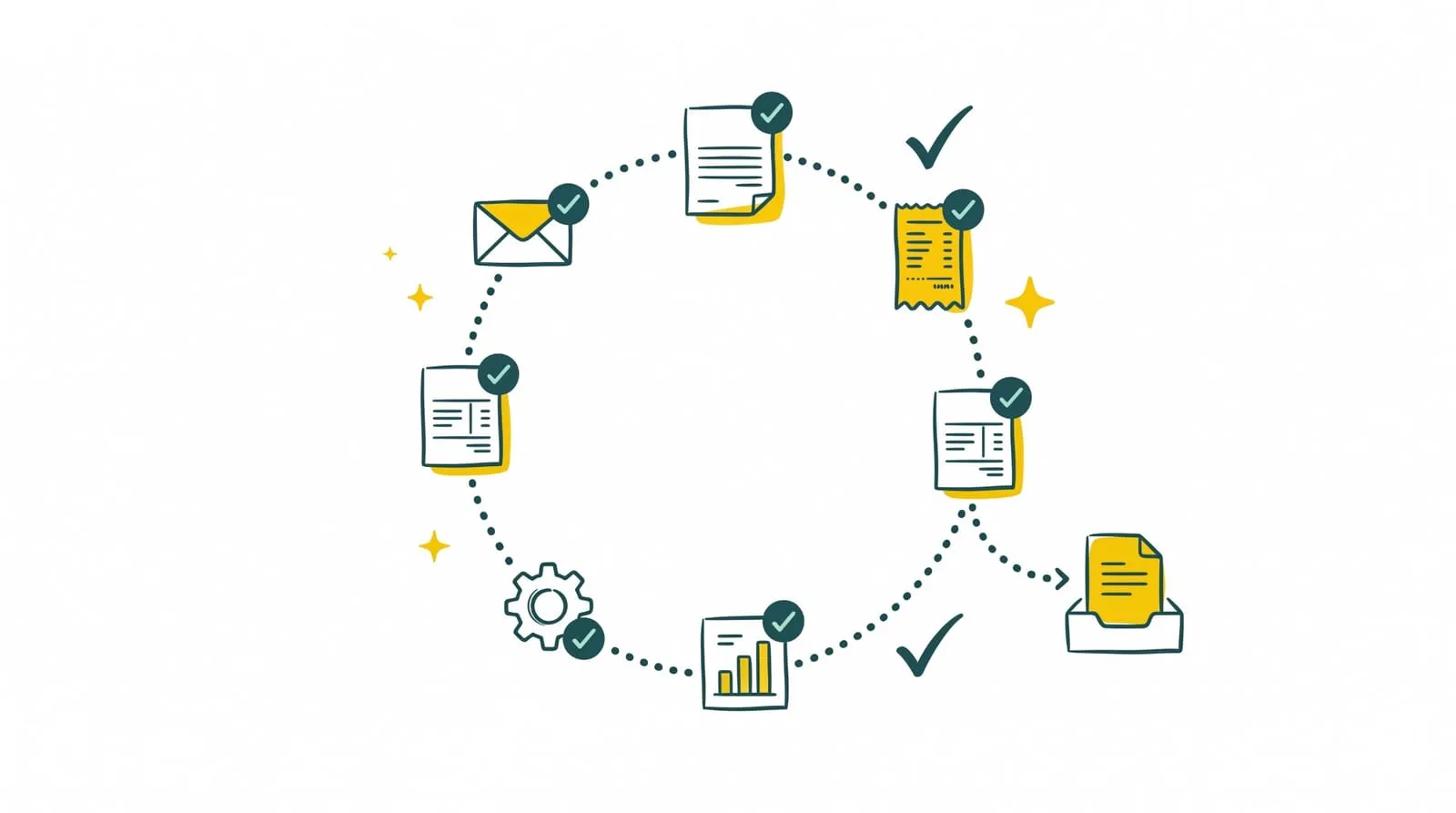
An invoice is waiting for approval in an email inbox. A payment has arrived, but nobody knows which invoice it belongs to. Meanwhile, an internal request is passed from one colleague to another without an answer. None of these tasks is especially complex. Together, they can take up a substantial part of the day.
AI can handle certain steps: finding information, sorting it, forwarding it, or flagging an overdue action. For an SME, the goal is to identify the operations that take up the team's time while keeping people in charge of checks and decisions. Here are seven processes to start with.
Key takeaways
- Internal process automation means assigning repetitive steps to tools: collecting information, checking it, passing it on, or triggering an action.
- In an SME, this can cover invoices and payments as well as internal requests and reports submitted by employees.
- AI helps process routine cases. People remain responsible for exceptions, approvals, and decisions that affect the business.
- For financial operations, Sanso handles invoice collection, bank reconciliation, and overdue payment tracking.
What is AI-powered internal process automation?
Automating an internal process means moving a task from one step to the next without requiring someone to do everything manually. Take a supplier invoice: it arrives by email, must be located, matched to the right supplier, checked, and sent to the person who approves it. If information is missing, someone needs to be alerted.
AI helps when this workflow requires reading and interpreting documents or messages. It can recognize that an attachment is an invoice, extract relevant details, and flag an inconsistency. The company still sets the rules: who receives the document, who approves it, and when a person must check it.
👉 The intended result is straightforward: less time spent tracking down a task's status and fewer operations left waiting in the wrong inbox.
7 internal operations SMEs can delegate to AI
1. Collect and organize supplier invoices
An invoice might arrive in the owner's inbox, in an employee's email, or several weeks after a purchase. Before it can even be recorded, someone must find it and check that it relates to a business expense.
An AI-powered tool can spot invoices in emails, read attachments, and extract the details needed to process them: supplier, date, amount, and invoice number. It can then file them in the right place and flag missing documents or details that need checking. The team no longer has to comb through every inbox to assemble the month's records.
2. Match payments to invoices
The description of a bank transaction does not always match the name on an invoice. A payment can also cover several documents or differ from the expected amount. These cases make bank reconciliation tedious when every document must be opened individually.
AI can suggest matches between bank transactions and available supporting documents. Straightforward transactions move ahead faster, while discrepancies are set aside for review. This leaves the person responsible for accounting more time for cases that genuinely require investigation or a decision.
3. Track due dates and follow up on overdue payments
When customer invoices are tracked in a spreadsheet, a late payment may go unnoticed until the next cash flow review. The team then has to find previous messages, check whether the customer has already paid, and decide who should contact them.
AI can identify past-due invoices, prepare a follow-up based on the account's history, and remind the team which invoices remain open. If a customer disputes an amount or asks for more time, the case leaves the automated workflow: a person needs to handle the conversation.
4. Sort and route internal requests
A question about an expense claim lands with the company owner. A document request goes to the sales team. Between forwarded messages and reminders, it is not always clear who should reply.
AI can identify the subject of a message, retrieve information that is already available, and send it to the right person. It can also flag a request that remains unanswered. To make this work, the SME must define a few simple rules: who handles each type of request and when an issue should be escalated to a manager.
5. Handle health, safety, and environment reports
An employee spots damaged equipment or a blocked emergency exit. They alert their manager, sometimes by sending a photo in a message. If the report stays in that conversation, it is hard to tell whether the issue has been assessed, who is responsible for fixing it, and when the work was done.
Hazelt, HSE incident reporting software, brings these reports together in one place. AI can help classify the risk and suggest actions; a manager then reviews the situation, assigns tasks, and tracks their completion. The employee can follow the progress of their report through to closure and see what action was taken.
6. Update customer and supplier records
A supplier changes contact details, a customer appears twice in a database, or an email address no longer works. Individually, these discrepancies may seem minor. Over time, they make follow-ups, payments, and information retrieval harder.
AI can spot duplicates and information that appears inconsistent, then suggest updates. Changes involving bank details, commercial terms, or a contact's identity should still be checked before they are saved.
7. Prepare recurring reports
At the end of each month, someone pulls the same figures from several tools to prepare an activity update. Part of this work is simply collecting data, putting it into a consistent format, and identifying what changed since the previous month.
AI can prepare an initial summary and highlight changes: more overdue invoices, an increase in certain expenses, or an unusual number of requests. A manager checks the figures and adds context before sharing them.
Which operation should an SME automate first?
A good starting point is often a task the team repeats every week and whose workflow is already understood. If nobody knows who should approve an invoice or respond to a request, adding AI will not settle that uncertainty. Responsibilities must be clarified first.
| Operation | Prioritize it if… | Check this first |
|---|---|---|
| Invoice collection | Supporting documents are scattered across several inboxes | Who approves collected documents |
| Bank reconciliation | The team frequently searches for documents related to payments | How mismatched amounts will be handled |
| Overdue payment follow-ups | Due dates are tracked manually | When to hand a case to a person |
| Internal requests | Messages are often forwarded between colleagues | Who responds to each type of request |
| HSE reports | Reports from the field get lost in conversations | Who assesses the risk and closes the action |
| Customer and supplier data | Duplicate and outdated records are multiplying | Which changes require approval |
| Reporting | The same data is copied every month | Who checks the figures before distribution |
To choose, consider how much time the task takes today, how often it occurs, and the consequences of an error. Then test automation on one workflow, measure the difference it makes, and fix bottlenecks before expanding it.
Automate your finance back office with Sanso
Supplier invoices, bank reconciliations, and overdue payments need regular attention. Yet the information needed to process them is often scattered across email, banking platforms, and accounting tools.
Sanso handles these operations for SMEs. By combining AI with financial expertise, Sanso automates up to 95% of your finance back-office tasks. Cases that require a check or a decision remain under human supervision.
Want to spend less time on repetitive finance tasks? Talk to the Sanso team to see which operations you could delegate.
Conclusion
Automating internal processes does not require an SME to redesign its entire organization. The most useful place to start is often where the team loses time every week: looking for invoices, matching payments, or following up on unanswered requests.
Choose one workflow, decide who checks exceptions, and observe what changes over the next few weeks. If information reaches the right place and cases move forward faster, you can apply the same approach elsewhere. AI then becomes part of everyday work while important decisions remain in human hands.