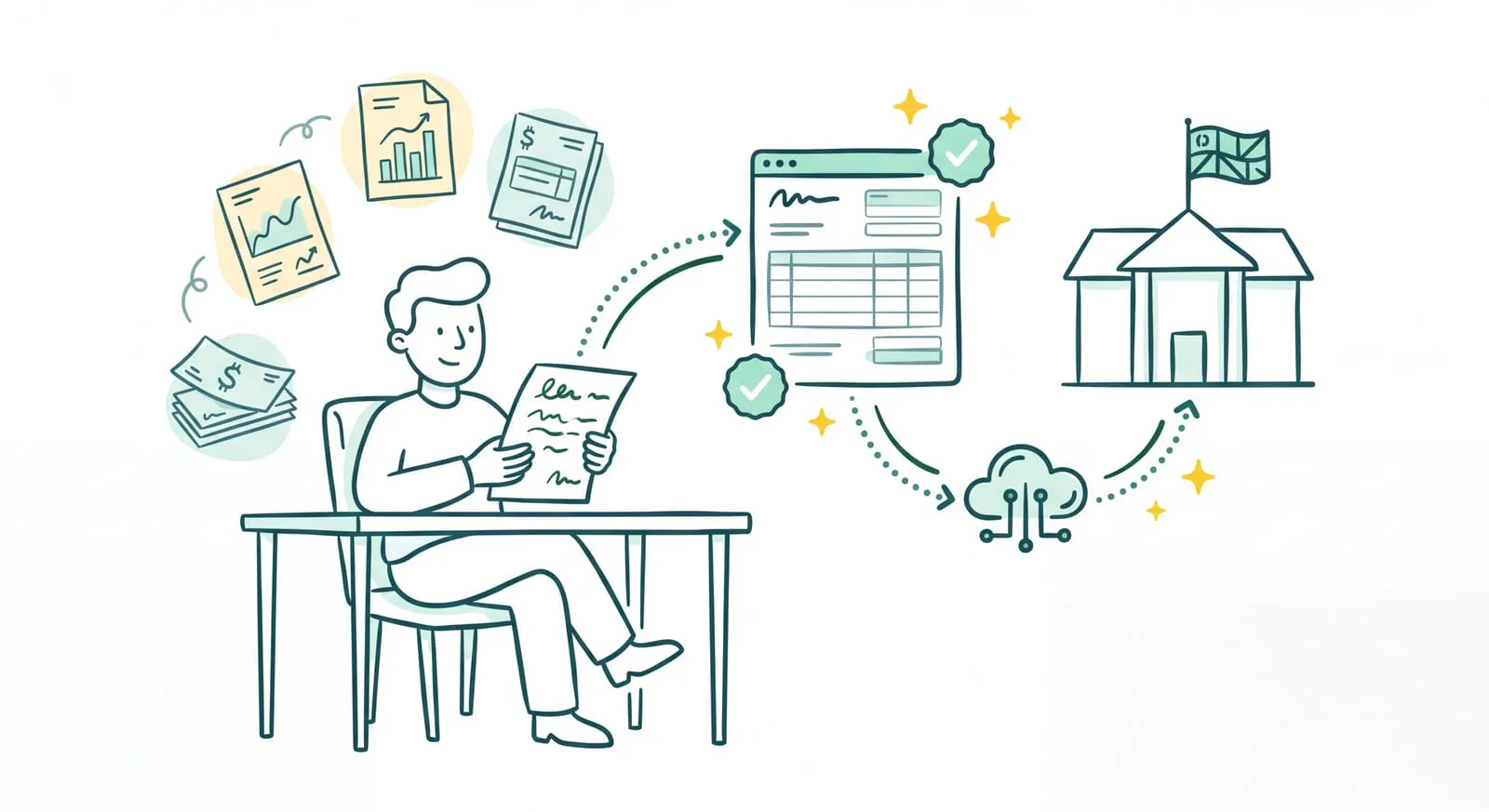
If you run a small business in France, the e-invoicing mandate has inevitably crossed your radar. And if you're like most business owners I meet, three questions keep running through your head, all very practical: does it apply to me, starting when, and what do I need to do beforehand.
I'm Amalia Bercot, co-founder and CEO of Sanso. At Sanso, we handle the day-to-day financial operations of SMBs: collecting supplier invoices, client invoicing, collections, bank reconciliation. The e-invoicing reform hits all of that work head-on. That's why I wanted to write a clear, jargon-free guide that tells you what you need to know and, above all, what you need to do.
So here are the essentials of e-invoicing for small businesses: the timeline, the obligations, and how to get ready without losing your evenings to it.
The mandate is coming, but who will handle your invoices day to day?
Sanso takes care of supplier invoice collection, client invoicing, and collections, directly in the tools you already use.
Book a CallE-Invoicing for Small Businesses: What Is It, Exactly?
Under the reform, an e-invoice is not just a PDF sent by email. It's an invoice issued, transmitted, and received in a structured format that software can read on its own, and from which the French tax authority collects the data directly.
The classic PDF, by contrast, remains a document designed for the human eye. A compliant e-invoice adds structured data that machines can use as-is. And that structured part is precisely what changes the game: less manual data entry, fewer errors, and automated tracking of each invoice's lifecycle.
The French reform recognizes three formats:
- Factur-X: a hybrid format that pairs a human-readable PDF with a structured data file tucked inside. It's often the most comfortable option for small businesses, because the invoice stays visually readable.
- UBL: a fully structured XML format.
- CII: another fully structured XML format.
Good news: you don't have to become an expert in these formats. Generating the right one is the job of your platform and your tools. Just remember one thing: a PDF forwarded by email will no longer cut it for a transaction between French businesses.
The E-Invoicing Mandate Timeline (2026-2027)
The reform rolls out in two stages, based on company size. The dates to keep in mind:
| Date | What becomes mandatory | Who it applies to |
|---|---|---|
| September 1, 2026 | Receiving e-invoices | All businesses subject to VAT |
| September 1, 2026 | Issuing e-invoices | Large companies and mid-sized companies (ETIs) |
| September 1, 2027 | Issuing e-invoices + e-reporting | Very small businesses (TPEs), SMBs, and micro-enterprises |
Two points in this timeline really deserve a closer look.
First, the obligation to receive e-invoices applies to everyone from September 1, 2026, small businesses included. You may well have until 2027 to issue your own invoices in electronic format, but your large-company and ETI suppliers will start sending you theirs from September 2026. By that date, you'll already need to know how to receive and process them.
Second, small businesses have until September 1, 2027 to issue their invoices in electronic format and to transmit their transaction data to the tax authority. That extra year is there to give you time to get organized. It's not an invitation to wait until the last minute, but it does take the pressure off a big-bang switchover on September 1, 2026.
Who Is Affected and What Actually Changes
The reform covers every business, freelancer, and independent professional subject to VAT in France, regardless of size, revenue, legal structure, or tax regime. As soon as you invoice other French businesses (domestic B2B transactions), you're in scope.
In practice, it rests on two distinct obligations.
E-Invoicing: Issuing and Receiving Electronic Invoices
For your transactions with other French businesses subject to VAT, invoices will have to travel in electronic format, through an accredited platform. No more emailing the invoice straight to your client: it will pass through a platform, which will in turn transmit it to your client's platform and to the tax authority.
E-Reporting: Transmitting Certain Data to the Tax Authority
For the transactions that e-invoicing doesn't cover (sales to consumers, foreign clients), you'll have to transmit transaction and payment data to the French tax authority. That's what's called e-reporting.
On the government's side, the goal is twofold: fighting VAT fraud and simplifying tax filings. On the business owner's side, the most visible change will be how your invoices leave and arrive: no longer by email, but through a platform.
How to Make the Switch to E-Invoicing
The switch to e-invoicing comes down to a few preparation steps. Here's how I recommend approaching it, without turning it into a project blown out of all proportion.
Tools that don't talk to each other, double data entry eating your time?
Sanso plugs into Pennylane, Qonto, or Google Workspace and connects the dots for you, with no new software to learn.
Book a Call1. Choose Your Accredited Platform (PA)
This is the decision that shapes everything else. Starting September 1, 2026, your invoices will have to pass through a state-accredited platform (PA), formerly called a plateforme de dématérialisation partenaire (PDP), either directly or through a compatible solution. Every business designates its own, to issue, receive, and report.
The good news: if you already work with a tool like Pennylane, your software includes or connects to an accredited platform. There's no automatic need to hunt down a separate provider. The right reflex: ask your software vendor how they plan to handle compliance with the reform.
2. Clean Up Your Client and Supplier Data
A structured e-invoice runs on reliable data: your clients' SIREN numbers, accurate contact details, up-to-date mandatory invoice information. If your client database is a little approximate, now is the time to straighten it out. One wrong piece of data, and the platform can simply reject the invoice.
3. Prepare to Receive E-Invoices From 2026
Sure, your obligation to issue only starts in 2027, but get organized as early as 2026 to receive and process your suppliers' e-invoices. Concretely: know where they land, how they get into your accounting tool, and who makes sure none slips through the cracks.
4. Check That Your Tools Talk to Each Other
Your invoicing software, your accounting tool, your bank: all of them need to play together, or e-invoicing ends up generating double data entry. This is often precisely where small businesses lose an enormous amount of time. The tools are all there, but day to day, nobody has a minute to connect them.
What the Reform Doesn't Solve (and Where Sanso Comes In)
The reform takes care of the plumbing: the invoice format, its transmission through an accredited platform, the reporting of data up to the tax authority. Essential, yes, but it doesn't touch the real work of financial management.
E-invoicing doesn't create the invoice for you. Yet in small businesses, around 5% of invoices quite simply never see the light of day: the work was done, but nobody thought to invoice it. The finest structured format can't do anything if the invoice itself doesn't exist.
Nor will it retrieve your supplier invoices scattered across inboxes and dozens of portals. It won't chase your late-paying clients. It won't match your bank transactions against your invoices. All of that operational work stays on the table, and it actually gets more demanding as everything goes digital.
That's exactly where Sanso comes in. Sanso is a service, not yet another piece of software to tame. We plug into the tools you already use, like Pennylane, Qonto, or Google Workspace, and we take over the day-to-day:
- Collecting supplier invoices, wherever they hide: in your emails, on your suppliers' portals, on WhatsApp. Our AI tells a real invoice from a mere quote, and sends it into your accounting tool.
- Creating and sending your client invoices, so none falls through the cracks, with the right amount and the right entity.
- Collections on overdue invoices, managed end-to-end, not some vague automated reminder.
- Real-time bank reconciliation, so you know at any moment who has paid and what's still outstanding.
Everything stays visible in your own tools, and you talk to your dedicated contact by email or WhatsApp, a bit like working with a freelancer. While the reform gets you compliant on the form, Sanso makes sure the substance follows: that your invoices exist, get collected, get paid, and get reconciled.
When you think about it, the e-invoicing reform actually comes at a good time to overhaul your financial operations. Instead of enduring 2026 and 2027 as a chore, you can make them the moment you finally stop chasing invoices.
Want to talk it through for your own business? Book a call with our team and let's look at what you could delegate.
5% of your invoices never go out. And your overdue payments?
Sanso makes sure every invoice exists, gets paid, and gets reconciled, while the reform keeps you compliant on the form.
Book a Call