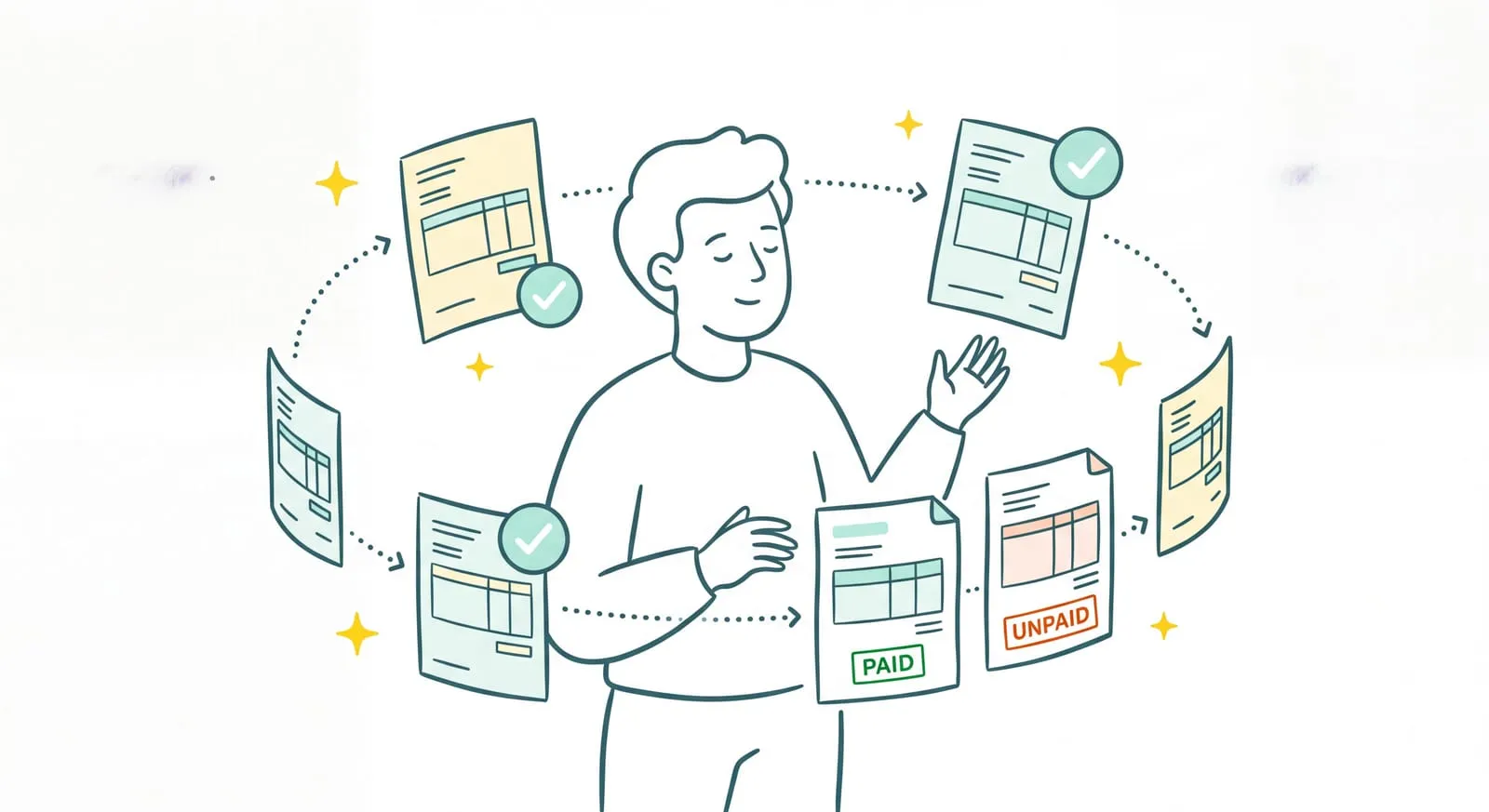
France's e-invoicing reform is no longer a distant deadline. On September 1, 2026, all French businesses subject to VAT will have to be able to receive their invoices electronically. Large companies and mid-sized companies (ETIs) will already have to issue them. For very small businesses (TPEs) and SMEs, issuing becomes mandatory a year later, on September 1, 2027. In short, the question is no longer whether you'll get around to it: you'll need to choose an e-invoicing platform to stay compliant.
I'm Amalia Bercot, co-founder and CEO of Sanso. We manage the day-to-day finance operations of dozens of small businesses, and one question comes up all the time: "Which platform should I go with, and how do I make sure I don't get it wrong?" That's what this guide answers. We'll look at what a PDP (accredited e-invoicing platform) really is, the timeline that applies to your specific case, the criteria for comparing offers, and what you absolutely need to check before signing anything.
Is the reform piling onto your to-do list?
Sanso uses AI to take over your small business's day-to-day finance operations, so the paperwork no longer rests on your shoulders.
Book a CallWhat Is an E-Invoicing Platform, Exactly?
An e-invoicing platform is the technical intermediary your invoices travel through, in a regulated format, between you, your clients, your suppliers, and the French tax authority. From September 2026, an invoice between two French businesses can no longer be a simple PDF sent by email. It will have to go through an accredited platform.
Three acronyms come up constantly in the reform, and it pays not to mix them up.
- The PPF (Portail Public de Facturation): France's public invoicing portal, run by the State. It no longer plays the free invoice-exchange role announced at the start. Today, it mainly serves as a business directory and a data hub for the tax administration. You can't issue and receive your invoices through the PPF alone: you need a platform alongside it.
- The PDP (Plateforme de Dématérialisation Partenaire): a private operator accredited by the French tax authority. A PDP is authorized to issue, transmit, and receive e-invoices, and to extract the data the administration needs. It's the type of platform most businesses will end up choosing.
- The OD (Opérateur de Dématérialisation): a provider that offers e-invoicing services but isn't accredited. An OD cannot transmit invoices directly to the administration: it has to go through a PDP.
In short: choosing an e-invoicing platform means, above all, choosing your PDP, in other words the accredited operator that will keep your invoices moving in full compliance.
The 2026-2027 Timeline: Who Must Do What, and When
The reform's timeline separates two obligations that have nothing to do with each other: receiving e-invoices on one side, issuing them on the other. And the dates change depending on the size of your company.
| Obligation | Effective Date | Businesses Affected |
|---|---|---|
| Receiving e-invoices | September 1, 2026 | All businesses subject to VAT (micro-enterprises, TPEs, SMEs, ETIs, large companies) |
| Issuing e-invoices | September 1, 2026 | Large companies and ETIs |
| Issuing e-invoices | September 1, 2027 | SMEs, TPEs, and micro-enterprises |
The key takeaway if you run a small business: from September 1, 2026, you must be able to receive e-invoices, even though your own obligation to issue them only arrives in 2027. So no, you can't push this back to 2027. From next year, your suppliers (large companies and ETIs first) will be sending you their invoices in electronic format. Without a platform, you simply won't be able to receive them properly.
That's exactly why this decision gets made now, not at the last minute. Choosing your e-invoicing platform calmly means comparing several offers, checking compatibility with your tools, and leaving yourself some time for setup.
How to Choose Your E-Invoicing Platform: The 7 Criteria
To choose an e-invoicing platform that truly fits your business, here are the seven criteria to review, starting with the most important.
1. Accreditation by the French Tax Authority
The non-negotiable criterion, and the one to start with. The platform must appear on the list of accredited PDPs, published and kept up to date on impots.gouv.fr. Be wary of solutions that advertise accreditation "in progress" with no firm date. Until the status is final, nothing guarantees you'll be compliant on deadline day.
2. Supported Formats and Interoperability
The reform requires specific structured formats: Factur-X (a hybrid format that combines a readable PDF with structured data), UBL, and CII. Your platform must handle these formats, but the truly decisive point is that it's interoperable with the other PDPs. Your clients and suppliers won't all be on the same platform as you, that's near certain. So yours must be able to talk to any other PDP on the market.
3. Connection to Your Existing Accounting Tool
A good platform shouldn't make you do the work twice. It must connect to your accounting tool, whether that's Pennylane, Tiime, Axonaut, Xero, or another. In fact, some French accounting tools like Pennylane are themselves becoming PDPs, or connecting to one. Check what's planned for yours: it can seriously simplify your choice.
Tired of re-keying everything by hand?
Sanso captures your invoices wherever they arrive, reads them with AI-powered OCR, and pushes them into your accounting tool, with no re-keying on your side.
Book a Call4. Handling Both Issuing and Receiving
The reform covers both flows. A platform that only handles issuing, or only receiving, won't cut it. Check that the solution covers the full cycle: issuing your customer invoices, receiving your supplier invoices, and tracking the mandatory statuses (submitted, rejected, payment received, etc.) throughout each invoice's life.
5. E-Reporting
On top of invoices between French businesses, the reform requires e-reporting: transmitting data on certain transactions to the administration, such as sales to consumers (B2C) or international transactions. If your activity includes these kinds of operations, your platform must be able to handle e-reporting, not just e-invoicing in the strict sense.
6. Data Security and Compliance
Your invoices contain sensitive information. Look at where the data is hosted (ideally in the European Union), GDPR compliance, and what the platform commits to on security. Archiving with legal evidential value, covering the full legal retention period, must also be included.
7. Cost and Terms
Compare pricing models. Some platforms charge by invoice volume, others offer a flat fee. Look at what's included, and above all what isn't. Think about reversibility too: if you switch platforms tomorrow, will you be able to retrieve and export all of your data and archived invoices?
What to Check Before You Sign
Before committing to a PDP, take five minutes to tick through this short checklist. These are the points that make the difference between a smooth transition and a few nasty surprises.
- Is the accreditation final? Cross-check the platform's name against the tax authority's official list, not just the vendor's sales brochure.
- Is interoperability guaranteed? Get written confirmation that the platform can exchange with every other PDP on the market.
- Is migration of existing records planned? Your in-progress supplier invoices, your templates, your client details: check that everything will be carried over cleanly.
- Is legal archiving included? Evidential-value retention must cover the full regulatory period, with no hidden cost surfacing later.
- Is reversibility real? Look at exactly how you'd retrieve your data the day you decide to leave.
- Is support up to the job? If you're stuck a few days before a tax deadline, you'll need responsive support, in French.
The Platform Doesn't Do the Work for You
It's the most commonly overlooked point in this reform. Choosing your e-invoicing platform settles the question of the invoice's regulated transport, not the financial work around it.
A PDP moves your invoices in the right format, to the right recipients, transmitting the data to the administration. That's necessary, but it stops there. It won't go find the supplier invoice buried at the bottom of your inbox or available only on a web portal. It doesn't check that an amount matches the approved quote. It doesn't reconcile your bank transactions with your invoices. And it doesn't follow up with clients who don't pay. All of that work still has to be done, and frankly, it's often what weighs heaviest day to day.
That's precisely Sanso's role. Sanso is a financial management service for small businesses that relies on AI to take over day-to-day operations. While your platform handles compliance, Sanso's AI does the actual work:
- Invoice capture, wherever they arrive: received by email, posted on a supplier portal, or sent over WhatsApp. The AI retrieves them, sorts real invoices from quotes and duplicates, then routes them to your accounting tool.
- Reading and understanding documents with AI-powered OCR. It doesn't just copy out the text: it understands what type of document it's looking at, extracts the right data, and uses context (the covering email, the history) to resolve ambiguities.
- Validation before payment: spotting duplicates, amount discrepancies against the quote, and VAT errors.
- Bank reconciliation and invoice matching in real time: for every bank transaction, the AI finds the matching invoice and updates its status, even when the labels don't line up neatly.
- Collections on unpaid invoices: personalized, multichannel follow-up, with the AI managing reminders and exchanges with your clients until you get paid.
And perhaps most important: there's no new tool for you to learn. Sanso plugs into your existing tools, your accounting software (Pennylane, Tiime, Axonaut, Xero), your bank (Qonto, Revolut Business, Float), and your Google Workspace, then works in the background. You see the results where you're used to seeing them, and you talk to us like a member of your team: email, WhatsApp, Slack, or phone.
The e-invoicing reform is actually a good opportunity to sort things out. Once the platform is chosen for compliance, the real question becomes: who's actually going to process all these invoices? If the answer is "me, in the evening, by hand," that's exactly where Sanso saves you a huge amount of time.
And who will process all these invoices?
While your platform handles compliance, Sanso uses AI to capture, validate, and reconcile your invoices and follow up on unpaid ones, directly in your existing tools.
Book a Call